Surface Tension Apparatus
Product Code : EL-EAST-10420
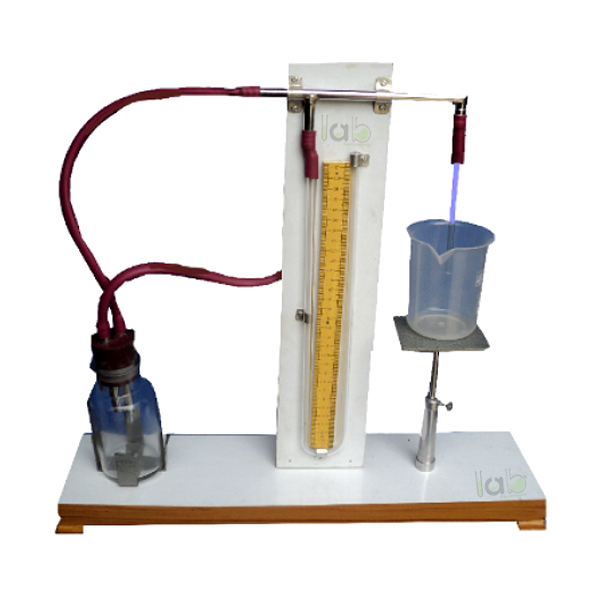
Quick answer: The Surface Tension Apparatus measures the surface tension of a liquid by the bubble pressure method, using a manometer and capillary tube mounted on a wooden stand and a wide-mouth reagent bottle with a dropping funnel in a two-holed cork. It is supplied without an aspirator. Lab Exports manufactures it in Delhi for schools, colleges and universities.
Specifications
| Item | Specification |
|---|---|
| Includes | Manometer, capillary tube, wide-mouth reagent bottle |
| Stand | Wooden, with manometer and capillary tube mounted |
| Bottle fitting | Two-holed cork, one hole fitted with a dropping funnel |
| Aspirator | Not included |
How the surface tension experiment is done
The apparatus follows the maximum bubble pressure method, often called Jaeger's method. Water run slowly from the dropping funnel into the closed reagent bottle displaces air and raises the pressure inside. That air is led to the manometer and to the capillary tube, whose tip dips a known depth into the test liquid, and a bubble slowly grows at the tip.
The pressure needed to push the bubble out is greatest when the bubble is a hemisphere with the same radius r as the capillary; at that moment the excess pressure is 2T/r. The manometer reading just before the bubble breaks away, less the hydrostatic pressure of the liquid above the tip, gives T = (r g/2)(H rho_m - h rho), where H is the manometer difference, rho_m the manometer liquid density, h the depth of the tip and rho the density of the test liquid.
- Fix the capillary tube vertically so its tip dips a measured depth h into the liquid in a beaker.
- Fill the dropping funnel with water and let it drip slowly into the reagent bottle.
- Watch bubbles form at the capillary tip and note the maximum manometer difference H just before each bubble breaks away.
- Repeat for several bubbles and depths, measure the capillary radius and calculate T.
Key features
- Manometer-based measurement of the pressure needed to form a bubble
- Dropping funnel in a two-holed cork gives a slow, controlled pressure rise
- Manometer and capillary tube pre-mounted on a wooden stand
- Wide-mouth reagent bottle serves as the air reservoir
- A pressure-based method to compare with capillary rise and torsion balance results
Documentation and supply
Most Lab Exports products carry a one-year manufacturer warranty.
Lab Exports manufactures the Surface Tension Apparatus at its works in Laxmi Nagar, Delhi, and supplies it to schools, colleges and universities in India and 60+ countries, handling the export documents for each shipment. More about the company is on the About Lab Exports page.
Related Elasticity and Surface Tension products
- Searle's Surface Tension Balance (EL-EAST-10419)
- Viscosity Apparatus Stokes Method (EL-EAST-10421)
- Quincke's Surface Tension Apparatus (EL-EAST-10418)
- Viscometer Searle's Pattern (EL-EAST-10422)
- Rising Table with Capillary Tube Clamp (EL-EAST-10417)
- Capillary Tube Clamp (EL-EAST-10416)
The full range is in the Elasticity and Surface Tension section of the Physics Lab range.
Frequently asked questions
What does the surface tension apparatus include?
A manometer and capillary tube mounted on a wooden stand, and a wide-mouth reagent bottle with a two-holed cork, one hole fitted with a dropping funnel.
Is an aspirator included?
No, the apparatus is supplied without an aspirator.
What is the price of the Surface Tension Apparatus?
Prices are not published on the website. Add the Surface Tension Apparatus to the Enquiry Cart with the Add To Cart button on this page, or email [email protected] with the house code EL-EAST-10420 and the quantity, to receive a quotation.
Does Lab Exports manufacture the Surface Tension Apparatus?
Yes. Lab Exports manufactures the Surface Tension Apparatus at its works at 11/315, Lalita Park, Laxmi Nagar, Delhi 110092, under house code EL-EAST-10420.
Request a quote
Email [email protected] with the house code EL-EAST-10420 and the quantity, or add the Surface Tension Apparatus to the Enquiry Cart with the Add To Cart button on this page. Tender buyers can also see the Tenders and OEM page.

.jpg)