Capillary Tube Clamp
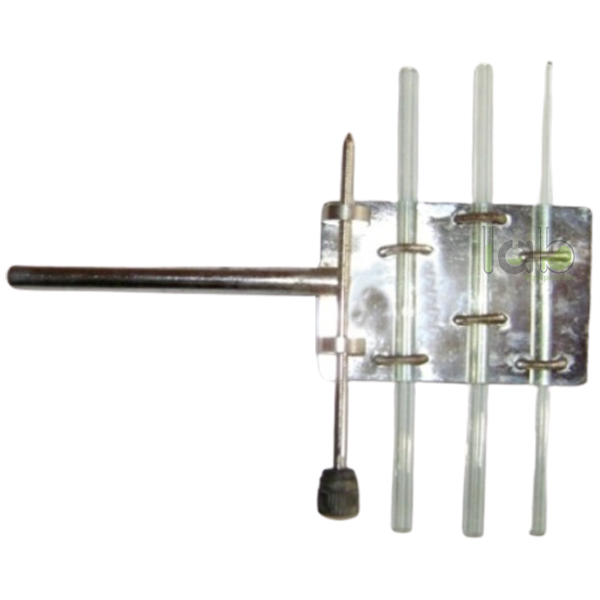
Product Code : EL-EAST-10416
Quick answer: The Capillary Tube Clamp holds four capillary tubes, each 10 cm long with a different internal diameter, on a metal frame with a 9 mm mounting rod. It is used to find the surface tension of a liquid by the capillary rise method and to compare the rise in different bores. Lab Exports manufactures it in Delhi for schools, colleges and universities.
Specifications
| Item | Specification |
|---|---|
| Capillary tubes | 4, each of different internal diameter |
| Tube length | 10 cm |
| Frame | Metal, with small metal brackets holding the tubes |
| Mounting rod | 9 mm, attached to the metal plate |
How the capillary rise experiment is done
When a clean, narrow glass tube is dipped into water, the liquid rises inside it until the upward pull of surface tension around the rim of the meniscus balances the weight of the raised column. This gives h = 2T cos(theta)/(r rho g), where T is the surface tension, r the internal radius, rho the density of the liquid and theta the angle of contact, which is close to zero for water in clean glass, so T = r h rho g/2.
Holding four tubes of different bore side by side shows the key prediction at a glance: the narrowest tube has the highest column, and the product r x h is the same for every tube. Checking that constancy is a good test of the students' measurements.
- Clean the capillary tubes, rinse them and let them dry.
- Fix the clamp's 9 mm rod in a laboratory stand so that the tubes hang vertically.
- Lower the tubes into the liquid in a beaker and let the columns settle.
- Measure the height of each column above the liquid surface, usually with a travelling microscope.
- Measure the internal radius of each tube, calculate T for each and compare the results.
Key features
- Four capillary tubes of different internal diameters in one set-up
- Each tube 10 cm long, held securely by small metal brackets
- Metal frame keeps all four tubes aligned and parallel
- 9 mm rod fits a standard laboratory stand clamp
- Shows the inverse relation between bore and capillary rise directly
Documentation and supply
Most Lab Exports products carry a one-year manufacturer warranty.
Lab Exports manufactures the Capillary Tube Clamp at its works in Laxmi Nagar, Delhi, and supplies it to schools, colleges and universities in India and 60+ countries, handling the export documents for each shipment. More about the company is on the About Lab Exports page.
Related Elasticity and Surface Tension products
- Poisson's Ratio of Rubber Apparatus (EL-EAST-10415)
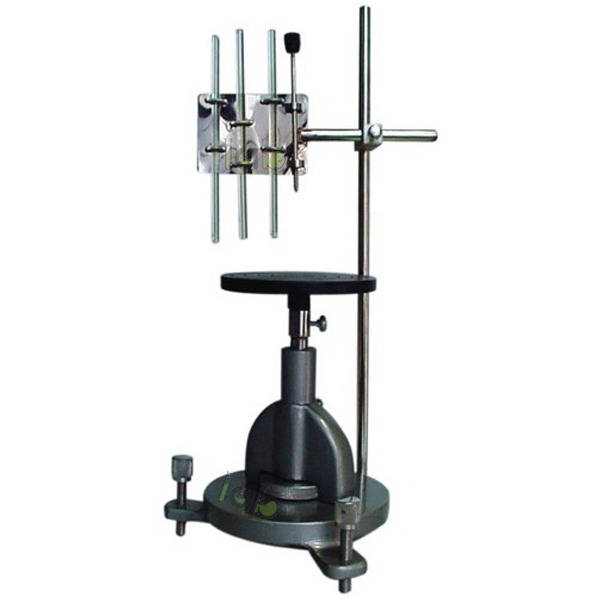
- Rising Table with Capillary Tube Clamp (EL-EAST-10417)
- Rigidity Apparatus (Searle's Pattern) (EL-EAST-10414)
- Quincke's Surface Tension Apparatus (EL-EAST-10418)
- Hooke's Law Apparatus (EL-EAST-10413)
- Searle's Surface Tension Balance (EL-EAST-10419)
The full range is in the Elasticity and Surface Tension section of the Physics Lab range.
Frequently asked questions
What experiment is the capillary tube clamp used for?
Determining the surface tension of a liquid by the capillary rise method, and comparing rise heights in tubes of different diameters.
How is the capillary tube clamp mounted?
A 9 mm rod attached to the metal plate fits into a standard laboratory stand.
Is there a version with a rising table?
Yes. The Rising Table with Capillary Tube Clamp pairs a similar clamp with an adjustable cast aluminium table for positioning the liquid vessel.
What is the price of the Capillary Tube Clamp?
Prices are not published on the website. Add the Capillary Tube Clamp to the Enquiry Cart with the Add To Cart button on this page, or email [email protected] with the house code EL-EAST-10416 and the quantity, to receive a quotation.
Does Lab Exports manufacture the Capillary Tube Clamp?
Yes. Lab Exports manufactures the Capillary Tube Clamp at its works at 11/315, Lalita Park, Laxmi Nagar, Delhi 110092, under house code EL-EAST-10416.
Request a quote
Email [email protected] with the house code EL-EAST-10416 and the quantity, or add the Capillary Tube Clamp to the Enquiry Cart with the Add To Cart button on this page. Tender buyers can also see the Tenders and OEM page.
.jpg)
.jpg)