Clinostat Electric
Product Code : EL-BLE-10628
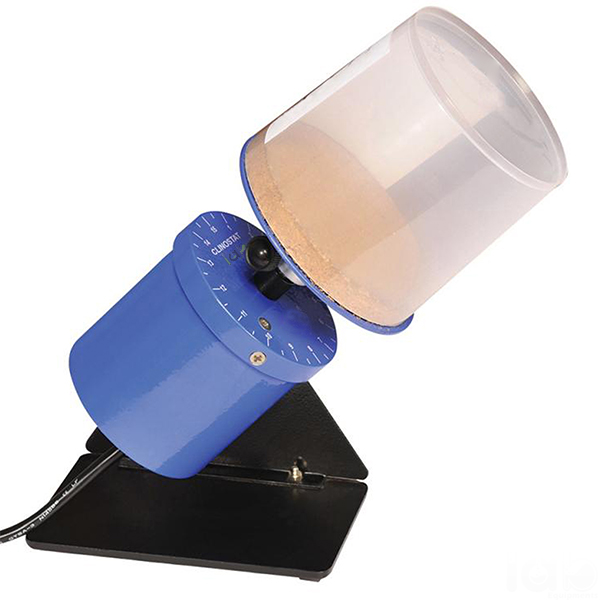
Quick answer: An electric clinostat is a slow motorised turntable that rotates a seedling or small plant so that gravity and light act evenly on all sides. It is used for geotropism and phototropism practicals on seedlings, cut shoots and small potted plants. The cork-faced disc turns at 5 revolutions per hour from a 220V, 50Hz supply. Lab Exports manufactures it in Delhi for schools, colleges and universities.
Specifications
| Parameter | Specification |
|---|---|
| Specimen disc | Cork-faced disc on a rotating turntable, with a fitting to take a specimen tube |
| Rotation speed | 5 revolutions per hour |
| Angle adjustment | Thumb screw, with a clear plastic cover |
| Power supply | 220V, 50Hz |
| Height | 300 mm |
| Mains cable | 3-core cable included |
For the disc diameter, email [email protected] with the house code.
How the clinostat experiment is done
A plant kept still responds to gravity: its root grows downward (positive geotropism) and its shoot grows upward (negative geotropism). On a clinostat the plant is turned slowly about a horizontal axis, so the pull of gravity falls on every side of the root and shoot in turn and no side receives a lasting one-sided stimulus. Slow rotation spreads one-sided light in the same way and cancels the phototropic bend.
Comparing a rotated plant with a stationary control therefore shows students that the bending is a growth response to a directional stimulus rather than a fixed habit of the plant.
- Germinate a few seeds until the radicles have emerged.
- Pin the seedlings to the cork-faced disc, or place a small shoot in the specimen tube fitting, with the roots pointing in different directions.
- Set the disc angle with the thumb screw so that the axis of rotation is horizontal, and connect the 3-core cable to a 220V, 50Hz socket.
- Pin a second set of seedlings the same way on a stationary support as the control.
- Run the clinostat for one to two days, keeping the seedlings moist, then compare root and shoot direction in both sets.
On the stationary control the roots curve downward and the shoots curve upward. On the clinostat the roots and shoots keep growing in the direction in which they were pinned, which shows that the curvature in the control is caused by gravity.
Key features
- Motor turns the specimen disc at a slow, steady 5 revolutions per hour
- Cork-faced disc takes pins directly, so seedlings can be fixed in any orientation
- Specimen tube fitting for holding a cut shoot or small plant
- Disc angle set with a thumb screw; the unit has a clear plastic cover
- Compact 300 mm height suits a bench or a window sill for phototropism trials
- Runs from 220V, 50Hz mains through the supplied 3-core cable
Documentation and supply
Installation instructions and a manual are supplied with the apparatus. Most Lab Exports products carry a one-year manufacturer warranty.
Lab Exports manufactures the electric clinostat at its works in Laxmi Nagar, Delhi, and supplies it to schools, colleges and universities in India and 60+ countries, handling the export documents for each shipment. More about the company is on the About Lab Exports page.
Related Biology Lab Equipment products
- Basic Plant Anatomy Slide (EL-BLE-10627)
- Effects of Smoking Model (EL-BLE-10629)
- Basic Botany Slide Set (EL-BLE-10626)
- Germination Model Activity Set (EL-BLE-10630)
- Respirometer (EL-BLE-10625)
- Dicot Leaf Model (EL-BLE-10631)
The full range is in the Biology Lab Equipment section of the Biology Lab range.
Frequently asked questions
What is a clinostat used for in biology?
It is used to study geotropism and phototropism. Slow rotation removes the one-sided effect of gravity or light on seedlings, cut shoots and small potted plants, so their growth can be compared with a stationary control.
How fast does the Lab Exports clinostat rotate?
The disc turns at 5 revolutions per hour, driven from a 220V, 50Hz mains supply.
Can the angle of the disc be changed?
Yes. The angle is adjusted with a thumb screw, and the unit is fitted with a clear plastic cover.
What is the price of the electric clinostat?
Prices are not published on the website. Add the electric clinostat to the Enquiry Cart with the Add To Cart button on this page, or email [email protected] with the house code EL-BLE-10628 and the quantity, to receive a quotation.
Does Lab Exports manufacture the electric clinostat?
Yes. Lab Exports manufactures the electric clinostat at its works at 11/315, Lalita Park, Laxmi Nagar, Delhi 110092, under house code EL-BLE-10628.
Request a quote
Email [email protected] with the house code EL-BLE-10628 and the quantity, or add the electric clinostat to the Enquiry Cart with the Add To Cart button on this page. Tender buyers can also see the Tenders and OEM page.