Monocot Stem T.S. Model
Product Code : EL-BLE-10633
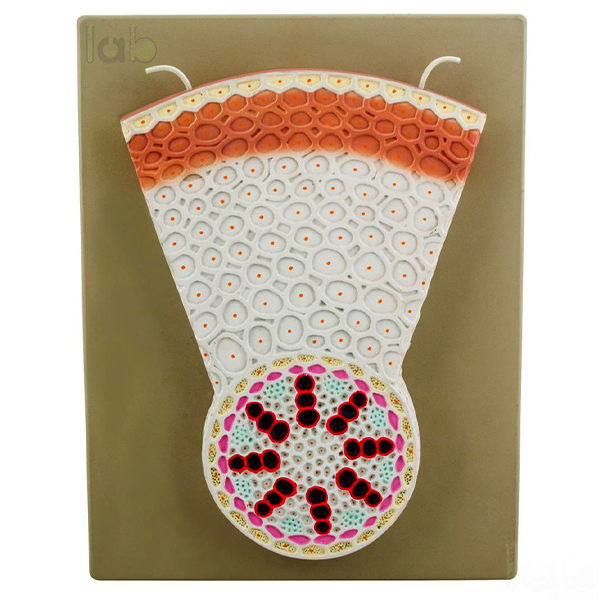
Quick answer: The monocot stem T.S. model shows a transverse section of a maize stem, with its tissues and scattered vascular bundles numbered to an English key card. It is used in botany classes to teach monocot stem anatomy and how its vascular bundles differ from those of a dicot stem. The model is 33 x 23 x 5 cm on a base. Lab Exports manufactures it in Delhi for schools, colleges and universities.
Specifications
| Item | Details |
|---|---|
| Section | Monocot (maize) stem, transverse section |
| Size | 33 x 23 x 5 cm (L x W x H), about 13 x 9 x 2 in |
| Mounting | On a base |
| Identification | Numbered, with English key card |
How the model is used in teaching
In a maize stem cut across, a single-layered epidermis and a narrow band of sclerenchymatous hypodermis surround a large mass of ground tissue. The vascular bundles are scattered through this ground tissue instead of forming a ring, and there is no clear division into cortex and pith. Each bundle is conjoint, collateral and closed: it has no cambium, so the stem does not undergo secondary growth, and it is wrapped in a sheath of sclerenchyma. Towards the outside the bundles are smaller and more crowded.
Seeing these features on a large model helps students recognise a monocot stem under the microscope and explain why maize and grasses do not thicken with age in the way many dicot stems do.
- Point out the epidermis and hypodermis at the edge of the section.
- Have students note how the vascular bundles are scattered and how their size changes from the centre to the edge.
- Use the English key card to name the parts of a single bundle, such as the xylem, phloem and bundle sheath.
- Compare the model with a dicot stem section and list the differences.
Key features
- Transverse section of a maize stem, a standard example of monocot stem anatomy
- Scattered vascular bundles shown clearly for comparison with the ring arrangement of dicots
- Numbered structures cross-referenced on an English key card
- Mounted on a base for bench or shelf display
- 33 x 23 x 5 cm size suited to group teaching
Documentation and supply
A numbered English key card is supplied with the model. Most Lab Exports products carry a one-year manufacturer warranty.
Lab Exports manufactures the monocot stem T.S. model at its works in Laxmi Nagar, Delhi, and supplies it to schools, colleges and universities in India and 60+ countries, handling the export documents for each shipment. More about the company is on the About Lab Exports page.
Related Biology Lab Equipment products
- Dicot Root T.S. Model (EL-BLE-10632)
- Microscope Cover Slips (EL-BLE-10634)
- Dicot Leaf Model (EL-BLE-10631)
- Desiccator (EL-BLE-10635)
- Germination Model Activity Set (EL-BLE-10630)
- Scalpel Blade (EL-BLE-10636)
The full range is in the Biology Lab Equipment section of the Biology Lab range.
Frequently asked questions
What does the monocot stem T.S. model show?
The tissues and vascular bundles of a maize stem in transverse section, numbered for identification with an English key card.
How does a monocot stem differ from a dicot stem?
In a monocot stem such as maize the vascular bundles are scattered through the ground tissue and have no cambium, whereas a dicot stem has its bundles arranged in a ring.
What size is the monocot stem model?
33 x 23 x 5 cm (L x W x H), about 13 x 9 x 2 inches, mounted on a base.
What is the price of the monocot stem T.S. model?
Prices are not published on the website. Add the monocot stem T.S. model to the Enquiry Cart with the Add To Cart button on this page, or email [email protected] with the house code EL-BLE-10633 and the quantity, to receive a quotation.
Does Lab Exports manufacture the monocot stem T.S. model?
Yes. Lab Exports manufactures the monocot stem T.S. model at its works at 11/315, Lalita Park, Laxmi Nagar, Delhi 110092, under house code EL-BLE-10633.
Request a quote
Email [email protected] with the house code EL-BLE-10633 and the quantity, or add the monocot stem T.S. model to the Enquiry Cart with the Add To Cart button on this page. Tender buyers can also see the Tenders and OEM page.