Hooke's Law Apparatus
Product Code : EL-EAST-10413
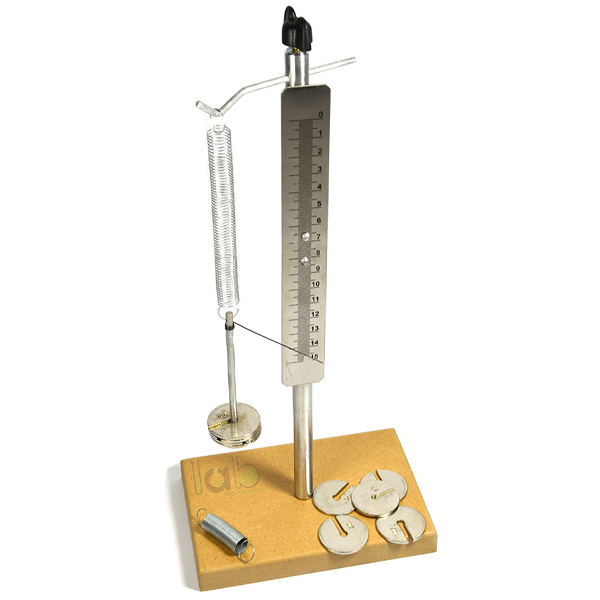
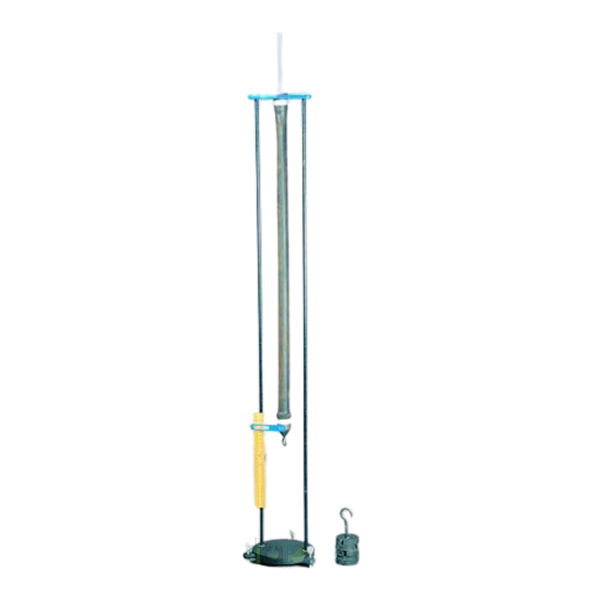
Quick answer: The Hooke's Law Apparatus verifies that the extension of a spring is proportional to the load and finds its spring constant. The standard version has a 30 cm mirror scale, spring, pointer and slotted weights with hanger on a stand; a 12 cm aluminium-scale version is also available. Lab Exports manufactures it in Delhi for schools, colleges and universities.
Specifications
| Item | Specification |
|---|---|
| Standard version | 30 cm mirror scale, spring, slotted weights with hanger and pointer, on stand |
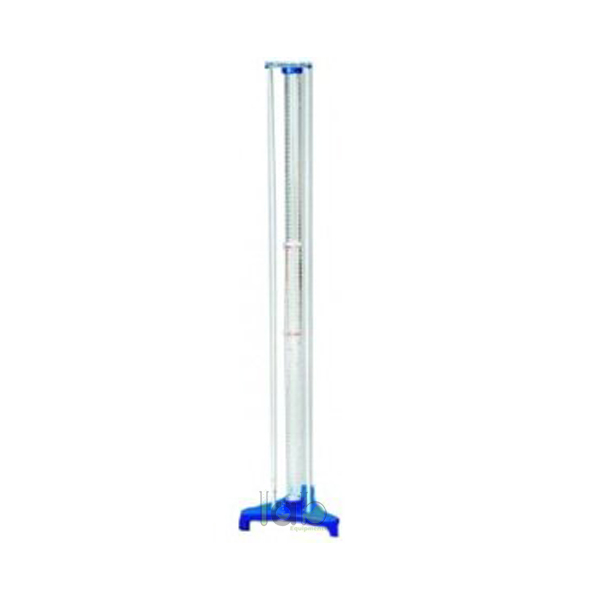
| Alternative version | 12 cm aluminium scale, spring, slotted weight hanger (without weights), on metallic stand |
| Principle demonstrated | Hooke's law (force-extension relationship) |
How the Hooke's law experiment is done
Hooke's law states that, within the elastic limit, the extension x of a spring is proportional to the force F stretching it: F = k x, where k is the spring constant in N/m. Hanging known masses on the spring and reading the pointer against the scale gives a set of force and extension values; their graph is a straight line through the origin, and its slope is k.
On the standard version the scale is a mirror scale. Lining the pointer up with its own reflection before reading puts the eye square to the scale, which removes parallax error and makes each reading more reliable.
- Stand the apparatus on a level bench and hang the spring with the pointer and hanger attached.
- Note the pointer reading with the empty hanger, keeping the pointer and its image in line.
- Add slotted weights one at a time, recording the pointer reading after each.
- Remove the weights in the same steps and record again to check the spring returns to its original length.
- Plot force (mg) against extension and find the spring constant from the slope.
Key features
- 30 cm mirror scale removes parallax error when reading the pointer
- Slotted weights with hanger allow progressive, even loading
- Pointer fitted to the spring for clear, repeatable readings
- Complete on a stand, ready for bench use
- Lighter 12 cm aluminium-scale version on a metallic stand for simpler set-ups
Documentation and supply
Most Lab Exports products carry a one-year manufacturer warranty.
Lab Exports manufactures the Hooke's Law Apparatus at its works in Laxmi Nagar, Delhi, and supplies it to schools, colleges and universities in India and 60+ countries, handling the export documents for each shipment. More about the company is on the About Lab Exports page.
Related Elasticity and Surface Tension products
- Young's Modulus Apparatus (Vernier Type) (EL-EAST-10412)
- Rigidity Apparatus (Searle's Pattern) (EL-EAST-10414)
- Young's Modulus Apparatus (Searle's Pattern) (EL-EAST-10411)
- Poisson's Ratio of Rubber Apparatus (EL-EAST-10415)
- Capillary Tube Clamp (EL-EAST-10416)
- Rising Table with Capillary Tube Clamp (EL-EAST-10417)
The full range is in the Elasticity and Surface Tension section of the Physics Lab range.
Frequently asked questions
What does the Hooke's law apparatus measure?
It shows the linear relationship between load and spring extension and is used to find the spring constant k from the slope of the force-extension graph.
Are slotted weights included?
Yes for the standard 30 cm mirror-scale version, which includes slotted weights with hanger. The 12 cm aluminium-scale version comes with a weight hanger but without weights.
What is the price of the Hooke's Law Apparatus?
Prices are not published on the website. Add the Hooke's Law Apparatus to the Enquiry Cart with the Add To Cart button on this page, or email [email protected] with the house code EL-EAST-10413 and the quantity, to receive a quotation.
Does Lab Exports manufacture the Hooke's Law Apparatus?
Yes. Lab Exports manufactures the Hooke's Law Apparatus at its works at 11/315, Lalita Park, Laxmi Nagar, Delhi 110092, under house code EL-EAST-10413.
Request a quote
Email [email protected] with the house code EL-EAST-10413 and the quantity, or add the Hooke's Law Apparatus to the Enquiry Cart with the Add To Cart button on this page. Tender buyers can also see the Tenders and OEM page.
.jpg)