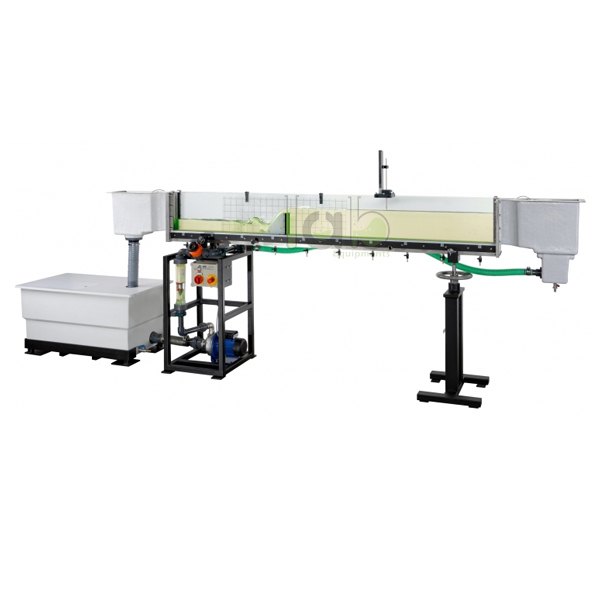
Pipe Network Apparatus
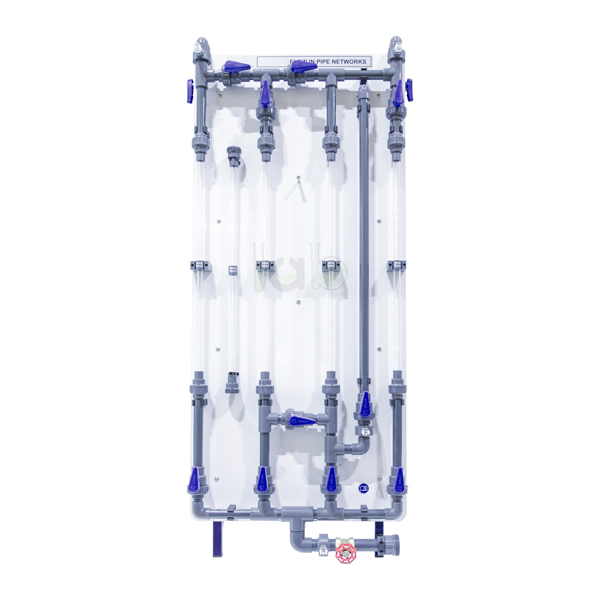
Product Code : EL-EFFCA-11077
Quick answer: The pipe network apparatus lets students measure head loss against discharge in interconnected pipes of different sizes, arranged as series and parallel networks. It shows how friction losses add in series, how flow divides between parallel branches and how resistance grows with the square of velocity. Lab Exports manufactures it in Delhi for engineering colleges, polytechnics and TVET institutes.
Specifications
| Aspect | Detail |
|---|---|
| Study focus | Flow through interconnected pipes of different sizes |
| Configurations | Series pipe networks and parallel pipe networks |
| Measurement | Head loss against discharge for different pipe sizes |
Pipe sizes, lengths and utility requirements are available from [email protected] on request.
How the pipe network experiment is done
Friction head loss in a pipe is given by the Darcy-Weisbach equation, hf = f L v^2 / (2 g D). The loss depends on the wetted surface, the fluid density and the roughness of the wall, is independent of the pressure in the pipe, and in turbulent flow rises roughly with the square of the velocity. Pipes of different diameter therefore give very different losses at the same discharge.
In series, the same flow passes through each pipe and the head losses add. In parallel, every branch sees the same head loss and the branch flows add up to the total. Real distribution networks combine both, and solving them by hand, for example by the Hardy Cross method, rests on exactly these two rules.
- Set up the pipes in a series or a parallel arrangement.
- Set a steady discharge and record it.
- Measure the head loss across each pipe or branch.
- Repeat for several discharges and plot head loss against discharge on log axes.
Key features
- Pipes of different sizes connected into a network
- Both series and parallel arrangements can be studied
- Direct measurement of head loss against discharge
- Shows the dependence of friction on wetted surface, density and roughness
- Demonstrates that friction loss is independent of pressure and rises with the square of velocity
Documentation and supply
Installation instructions and a manual are supplied with the apparatus. Most Lab Exports products carry a one-year manufacturer warranty.
Lab Exports manufactures the pipe network apparatus at its works in Laxmi Nagar, Delhi, and supplies it to engineering colleges, polytechnics and TVET institutes in India and 60+ countries, handling the export documents for each shipment. More about the company is on the About Lab Exports page.
Related Experimental Flume Flow Channel Apparatus products
- Flow Channel Apparatus (EL-EFFCA-11076)
- Digital Level Gauge (EL-EFFCA-11075)
- Velocity Meter (EL-EFFCA-11072)
- Pitot Static Tube (EL-EFFCA-11071)
- Broad Crested Weir (EL-EFFCA-11070)
- Extension Element of the Experimental Flume (EL-EFFCA-11069)
The full range is in the Experimental Flume Flow Channel Apparatus section of the Engineering Lab range.
Frequently asked questions
What does the pipe network apparatus study?
It studies flow and head loss through interconnected pipes of different sizes arranged in series and in parallel.
How do head losses behave in series and parallel pipes?
In series the flow is the same in each pipe and the losses add; in parallel the head loss is the same across each branch and the flows add.
What is the price of the pipe network apparatus?
Prices are not published on the website. Add the pipe network apparatus to the Enquiry Cart with the Add To Cart button on this page, or email [email protected] with the house code EL-EFFCA-11077 and the quantity, to receive a quotation.
Does Lab Exports manufacture the pipe network apparatus?
Yes. Lab Exports manufactures the pipe network apparatus at its works at 11/315, Lalita Park, Laxmi Nagar, Delhi 110092, under house code EL-EFFCA-11077.
Request a quote
Email [email protected] with the house code EL-EFFCA-11077 and the quantity, or add the pipe network apparatus to the Enquiry Cart with the Add To Cart button on this page. Tender buyers can also see the Tenders and OEM page.