Concave Lens
Product Code : SCL-LAO-11235
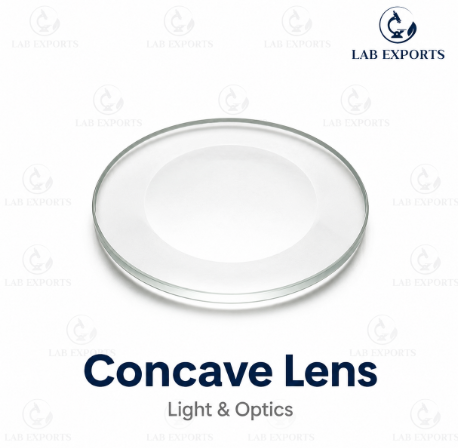
Quick answer: A concave lens is a diverging lens, thinner at the centre than at the edges, that spreads parallel rays so they appear to come from a virtual focus. Students use it to see virtual, upright, diminished images and to find its focal length in combination with a convex lens. Diameters are 50 mm and 75 mm. Lab Exports manufactures it in Delhi for schools, colleges and universities.
Specifications
| Parameter | Detail |
|---|---|
| Lens type | Concave (diverging), thinner at the centre |
| Diameters | 50 mm or 75 mm (nominal) |
| Image of a real object | Virtual, upright and diminished |
| Power | None; passive optical component |
| Supplied as | One lens in the selected diameter |
Focal length and lens material are confirmed with the quotation.
How the concave lens is used
Because a concave lens diverges light, it never forms a real image of a real object on a screen, so its focal length cannot be found by the simple screen method used for a convex lens. The usual school method combines it with a stronger convex lens so that the pair still forms a real image. For two thin lenses in contact 1/F = 1/f1 + 1/f2, so the concave lens focal length follows from the measured F and the known convex lens.
- Mount the lens upright in a holder and direct narrow parallel rays from a ray box at it.
- Trace the diverging rays on paper and extend them backwards; they meet at the virtual principal focus.
- For a measured value, place the concave lens in contact with a convex lens of shorter focal length and find the focal length F of the pair.
- With the convex lens focal length f1 known, calculate f2 from 1/F = 1/f1 + 1/f2; the result is negative for a diverging lens.
Key features
- Offered in nominal 50 mm and 75 mm diameters for compatible holders.
- Diverging action spreads parallel rays after refraction, clear to see with a ray box.
- Shows the virtual, upright and diminished image that sets it apart from a convex lens.
- Pairs with a convex lens for the lens-combination focal length method.
- Passive component with no power supply, reusable over many practical sessions.
Documentation and supply
Most Lab Exports products carry a one-year manufacturer warranty.
Lab Exports manufactures the concave lens at its works in Laxmi Nagar, Delhi, and supplies it to schools, colleges and universities in India and 60+ countries, handling the export documents for each shipment. More about the company is on the About Lab Exports page.
Related Light and Optics products
- Convex Lens (SCL-LAO-11234)
- Concave Mirror (SCL-LAO-11236)
- Convex Mirror (SCL-LAO-11237)
- Ray Optics Kit (SCL-LAO-11229)
- Magnifier Glass 3" (SCL-LAO-11225)
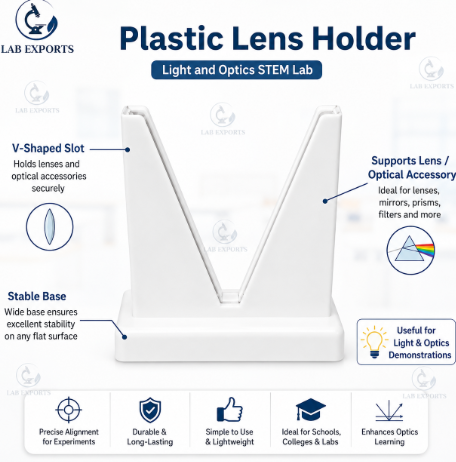
- Lens Holder V Shape (SCL-LAO-11253)
The full range is in the Light and Optics section of the Physics Lab range.
Frequently asked questions
Why can a concave lens not form an image on a screen?
It diverges light, so the refracted rays never actually meet; they only appear to come from a point on the object side, giving a virtual image that is seen through the lens, not on a screen.
How is the focal length of a concave lens measured?
By ray tracing to its virtual focus, or by combining it with a stronger convex lens, measuring the focal length of the pair and using 1/F = 1/f1 + 1/f2.
What is the price of the concave lens?
Prices are not published on the website. Add the concave lens to the Enquiry Cart with the Add To Cart button on this page, or email [email protected] with the house code SCL-LAO-11235 and the quantity, to receive a quotation.
Does Lab Exports manufacture the concave lens?
Yes. Lab Exports manufactures the concave lens at its works at 11/315, Lalita Park, Laxmi Nagar, Delhi 110092, under house code SCL-LAO-11235.
Request a quote
Email [email protected] with the house code SCL-LAO-11235 and the quantity, or add the concave lens to the Enquiry Cart with the Add To Cart button on this page. Tender buyers can also see the Tenders and OEM page.