Anemometer Model
Product Code : SCL-LM-11118
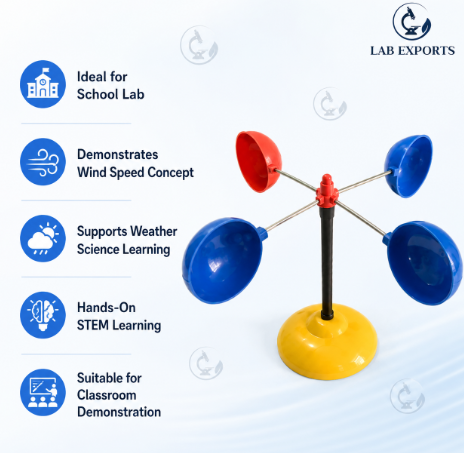
Quick answer: The Anemometer Model is an educational cup anemometer, built on the Robinson pattern, that turns in a breeze or in the air stream from a fan so students can see how wind speed is measured. Hemispherical cups on horizontal arms spin a vertical spindle on a low-friction pivot, with no power needed. Lab Exports manufactures it in Delhi for schools and colleges.
Specifications
| Component | Specification |
|---|---|
| Design | Rotational cup anemometer (Robinson type) |
| Rotor | Hemispherical cups on horizontal arms around a central vertical axis |
| Pivot | Low-friction pivot, responds to gentle air currents |
| Mounting | On a base, for bench or outdoor use |
| Power | None, fully mechanical |
| Supplied | Fully assembled model and an instructional guide on wind speed calculation |
How the model is used in teaching
Wind pressing on the hollow side of each cup is greater than on the rounded back of the cup opposite, so the rotor turns, and the stronger the wind, the faster it spins. Counting the turns over a set time gives the rotation rate N in revolutions per minute. The speed of the cups is then v = 2 pi r N / 60, where r is the distance from the spindle to the centre of a cup.
- Place the anemometer on a level surface in the open, or in front of a table fan for an indoor lesson.
- Mark one cup and count its turns for one minute.
- Measure the radius from the spindle to the cup centre and calculate the cup speed from v = 2 pi r N / 60.
- Repeat at different fan settings or places around the school grounds and compare the results.
Because the cups move more slowly than the wind itself, weather stations apply a calibration factor to convert cup speed into wind speed. Discussing this factor shows students the difference between a teaching model and a calibrated instrument, and links the lesson to energy conversion from moving air to rotation.
Key features
- Classic cup design that turns straight-line air movement into rotation.
- Low-friction pivot, so the rotor responds even to gentle air currents.
- Purely mechanical, with no batteries or mains supply needed.
- Base mounting for indoor demonstrations with a fan and for outdoor field studies.
- Supplied fully assembled with an instructional guide on wind speed calculation.
Documentation and supply
An instructional guide on wind speed calculation is supplied with the model. Most Lab Exports products carry a one-year manufacturer warranty.
Lab Exports manufactures the anemometer model at its works in Laxmi Nagar, Delhi, and supplies it to schools and colleges in India and 60+ countries, handling the export documents for each shipment. More about the company is on the About Lab Exports page.
Related Lab Meters products
- Digital Ohms Meter - 20K ohm (SCL-LM-11116)
- Analog Frequency Meter (SCL-LM-11129)
- Analog Stop Clock (SCL-LM-11103)
- Digital LCD Ammeter (SCL-LM-11096)
- Analog Ammeter Panel (SCL-LM-11151)
- Analog Voltmeter Panel Type (SCL-LM-11152)
The full range is in the Lab Meters section of the Physics Lab range.
Frequently asked questions
How does a cup anemometer measure wind speed?
The wind pushes harder on the open faces of the cups than on their rounded backs, so the rotor spins at a rate that rises with wind speed. Counting revolutions per minute and using the rotor radius gives the cup speed.
Does the anemometer model need a power supply?
No. It is purely mechanical and works in a natural breeze or in front of a fan.
What is the price of the anemometer model?
Prices are not published on the website. Add the anemometer model to the Enquiry Cart with the Add To Cart button on this page, or email [email protected] with the house code SCL-LM-11118 and the quantity, to receive a quotation.
Does Lab Exports manufacture the anemometer model?
Yes. Lab Exports manufactures the anemometer model at its works at 11/315, Lalita Park, Laxmi Nagar, Delhi 110092, under house code SCL-LM-11118.
Request a quote
Email [email protected] with the house code SCL-LM-11118 and the quantity, or add the anemometer model to the Enquiry Cart with the Add To Cart button on this page. Tender buyers can also see the Tenders and OEM page.