Zener Diode Unit
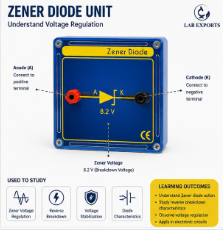
Product Code : SCL-EAE-11266
Quick answer: The Zener Diode Unit is used to study a Zener diode in forward and reverse bias. With a regulated DC supply, a current-limiting resistor and meters, students plot its characteristics, find the voltage at which reverse breakdown begins, and see how it holds a nearly steady voltage as a shunt regulator. Lab Exports manufactures it in Delhi for schools, colleges and universities.
Specifications
| Parameter | Detail |
|---|---|
| Semiconductor | Zener diode |
| Terminals | Anode and cathode, marked on the unit |
| Category | Physics laboratory equipment, electronics |
Diode type, Zener voltage and power rating are not listed on this page; email [email protected] with the house code. Power supply, current-limiting resistor, leads and meters are not part of the listed supply.
How the Zener diode experiment is done
A Zener diode is a heavily doped PN junction. In forward bias it behaves like an ordinary diode, conducting beyond about 0.7 V for silicon. In reverse bias only a tiny leakage current flows until the Zener breakdown voltage VZ is reached; then the current rises sharply while the voltage across the diode stays almost constant. That is why a Zener diode connected in reverse across a load, with a series resistor, acts as a simple voltage regulator.
- Identify the anode and cathode terminals marked on the unit.
- Connect the diode in reverse bias with a current-limiting resistor, a milliammeter in series and a voltmeter across the diode.
- Raise the supply slowly from zero and record the diode voltage and current at each step.
- Note the voltage at which the current starts to rise sharply; this is the Zener voltage.
- Reverse the connections and repeat for the forward characteristic, then plot both on one graph.
For the regulation experiment a load is placed across the diode and the input voltage is varied: above breakdown, the load voltage stays close to VZ even as the input changes.
Key features
- Zener diode for forward and reverse bias study
- Makes the breakdown region and Zener voltage measurable
- Demonstrates basic shunt voltage regulation
- Works with standard meters to record voltage and current
- Allows comparison with an ordinary PN junction diode
- Reusable when operated within its rating
Documentation and supply
Most Lab Exports products carry a one-year manufacturer warranty.
Lab Exports manufactures the Zener diode unit at its works in Laxmi Nagar, Delhi, and supplies it to schools, colleges and universities in India and 60+ countries, handling the export documents for each shipment. More about the company is on the About Lab Exports page.
Related Electrical and Electronics products
- NPN Transistor Unit (SCL-EAE-11265)
- PN Junction Diode Unit (SCL-EAE-11267)
- PNP Transistor Unit (SCL-EAE-11264)
- Solar Energy Kit 4 in 1 (SCL-EAE-11268)
- Daniel Cell (SCL-EAE-11263)
- Resistance Coil Unit (SCL-EAE-11262)
The full range is in the Electrical and Electronics section of the Physics Lab range.
Frequently asked questions
What is the Zener breakdown voltage?
It is the reverse voltage at which the Zener diode starts to conduct strongly. Above it, the diode voltage stays almost constant while the current changes.
Why is a series resistor used with the Zener diode?
It limits the current once breakdown is reached, so the diode is not damaged by excessive current and power.
What is the price of the Zener diode unit?
Prices are not published on the website. Add the Zener diode unit to the Enquiry Cart with the Add To Cart button on this page, or email [email protected] with the house code SCL-EAE-11266 and the quantity, to receive a quotation.
Does Lab Exports manufacture the Zener diode unit?
Yes. Lab Exports manufactures the Zener diode unit at its works at 11/315, Lalita Park, Laxmi Nagar, Delhi 110092, under house code SCL-EAE-11266.
Request a quote
Email [email protected] with the house code SCL-EAE-11266 and the quantity, or add the Zener diode unit to the Enquiry Cart with the Add To Cart button on this page. Tender buyers can also see the Tenders and OEM page.