Solar Irradiance Meter

Solar Irradiance Meter
Product Code : SCL-EAE-11348

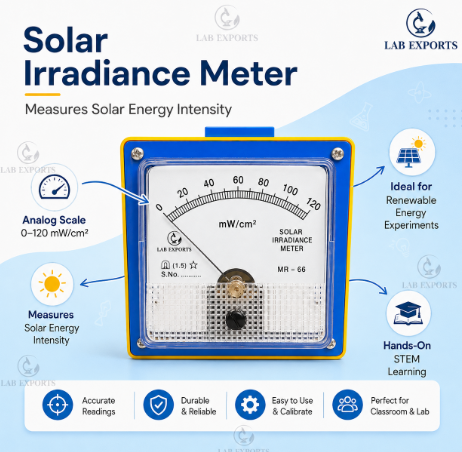
The Solar Irradiance Meter is a measuring instrument used for determining the intensity of incident solar radiation at a selected location. It helps students, laboratory personnel, solar technicians and researchers evaluate available sunlight during photovoltaic experiments, renewable-energy studies and preliminary solar site assessments.

Product Data

Brand: Lab Exports

Product category: Solar Radiation Measurement Instrument

Intended users: Schools, colleges, universities, renewable-energy laboratories, technical training centres, solar technicians and research organisations

Standards or certifications: No product-specific certification or calibration standard publicly confirmed

Primary keyword: Solar Irradiance Meter

Semantic keywords: solar radiation meter, photovoltaic irradiance meter, solar power meter, sunlight intensity meter, solar energy measurement instrument, PV testing equipment

Product Description

A Solar Irradiance Meter measures incoming solar radiation at the instrument sensor. Irradiance is commonly expressed as power received per unit area, typically in watts per square metre. The measured value can help users compare sunlight conditions at different times, orientations or test locations.

The instrument is suitable for practical demonstrations and field-based solar studies. Users can position the sensor at the same angle as a photovoltaic module to obtain a relevant comparison reading. The exact sensor construction, measurement range, accuracy, resolution and enclosure material must be confirmed from the current Lab Exports technical datasheet.

Key Features

Direct irradiance measurement: Measures incident solar radiation for laboratory or field observations.

Photovoltaic testing value: Helps relate available sunlight to the output of a solar panel or experimental PV system.

Comparative measurements: Supports readings at different panel angles, times and locations.

Hands-on instruction: Connects solar-radiation theory with quantitative measurement activities.

Multi-disciplinary use: Supports renewable energy, physics, environmental science and engineering studies.

Field-oriented method: Enables preliminary sunlight assessment when used within the instrument’s specified limits.

Reusable measurement tool: Suitable for repeated testing when the sensor is protected and maintained correctly.

Technical Specifications

Specification

Detail

Product name

Solar Irradiance Meter

Brand

Lab Exports

Capacity

Single measurement instrument

Measured parameter

Incident solar irradiance

Typical unit of measurement

Watts per square metre; available display units must be verified

What's Included in the Kit

Solar Irradiance Meter

The sensor arrangement, carrying case, batteries, protective cover, mounting accessories, operating manual and calibration documentation must be verified against the final Lab Exports packing list.

Applications / Uses

Measuring sunlight during photovoltaic laboratory experiments

Comparing solar irradiance at different module tilt angles

Evaluating the effects of cloud cover and shading

Supporting preliminary solar site observations

Relating PV module output to incident solar radiation

Teaching irradiance, power density and renewable-energy concepts

How to Use the Solar Irradiance Meter

Inspect the sensor surface and confirm that it is clean and undamaged.

Switch on the instrument and select the required measurement mode, where available.

Position the sensor in the plane in which irradiance is to be measured.

Keep hands, equipment and nearby objects from shading the sensor.

Allow the displayed value to stabilise before recording the reading.

Repeat measurements at the required angles, locations or times.

Record the environmental conditions with each result for meaningful comparison.

Safety note: Do not look directly at the sun. Avoid prolonged exposure of the instrument to excessive heat, rain or dust unless its environmental protection rating explicitly permits those conditions.

Care & Maintenance

Clean the sensor only with the method specified in the operating manual.

Store the meter in a dry protective case when it is not in use.

Protect the sensor from scratches, fingerprints and mechanical impact.

Arrange calibration or verification at the interval recommended for the required measurement quality.

Why Choose Lab Exports

Lab Exports manufactures, supplies and exports scientific laboratory equipment and educational teaching aids. Its portfolio includes physics apparatus, laboratory meters, electrical and electronics equipment, science kits and renewable-energy training products. The company supplies schools, colleges, universities and research facilities in international markets. Buyers should request the approved specifications, packing list and calibration documentation required for their application.

Frequently Asked Questions

What is a Solar Irradiance Meter used for?

It is used to measure incident solar radiation at a specific position and orientation. The reading helps users compare solar conditions during PV testing, education and site assessment.

What unit does a solar irradiance meter display?

Solar irradiance is typically reported in watts per square metre. The units available on this specific model must be confirmed from its datasheet.

Can it measure the performance of a solar panel?

It measures incident solar radiation rather than complete panel performance. Users can compare the irradiance reading with the panel’s voltage, current or power measured using suitable instruments.

Is the meter suitable for outdoor measurements?

It may be used for outdoor readings under permitted operating conditions. Its temperature limits, humidity limits and ingress-protection rating have not been publicly specified.

Does the Solar Irradiance Meter require calibration?

Measurement instruments should be verified or calibrated according to the accuracy required by the application. Buyers should confirm whether calibration documentation is supplied or available separately.

Can students use the meter in a laboratory?

Yes. It can support supervised experiments involving irradiance, shading, panel angle and photovoltaic output. Students should follow the operating manual and avoid direct observation of the sun.

Request the verified Solar Irradiance Meter datasheet and quotation, or explore Lab Exports’ solar energy training equipmentlaboratory instruments and complete physics laboratory equipment range.

Recommended Product Image ALT Text

Solar Irradiance Meter for photovoltaic testing by Lab Exports

Solar radiation meter sensor positioned in direct sunlight

Technician measuring irradiance beside a photovoltaic panel

Digital sunlight intensity measurement during a solar laboratory experiment

```

   
Supply of Solar Irradiance Meter from to Finland, France, Tanzania, Thailand, Sri Lanka, Congo, Costa Rica, Ivory Coast, Croatia, Cuba, Cyprus, Czech Republic, Denmark, Djibouti, Dominica, Afghanistan, Albania, Algeria, Andorra, Angola, Antigua and Barbuda, Argentina, Armenia, Australia, Austria, Azerbaijan, Bahamas, Bahrain, Bangladesh, Barbados, United Arab Emirates (UAE, Dubai), United Kingdom (London), United States, Uruguay, Uzbekistan, Vanuatu, Belarus, Belgium, Belize, Benin, Bhutan, Bolivia, Bosnia and Herzegovina, Botswana, Brazil, Brunei, Bulgaria, Burkina Faso, Burma Myanmar, East Timor, Ecuador, Egypt, El Salvador, Equatorial Guinea, Eritrea, Estonia, Ethiopia (Addis Ababa), Fiji, Burundi, Cambodia, Cameroon, Canada, Cape Verde, Central African Republic, Chad, Chile, Colombia. Math Teaching Kit suppliers in Luxembourg, Macedonia, Madagascar, Malawi (Lilongwe), Malaysia (Kuala Lumpur), Maldives, Mali, Malta, Marshall Islands, Mauritania, Mexico, Micronesia, Moldova, Monaco, Mongolia, Montenegro, Morocco, Mozambique, Namibia, Comoros, Congo. Math Teaching Kit manufacturers in Dominican Republic, Gabon, Gambia, Georgia, Germany, Ghana, Greece, Grenada, Guatemala, Guinea, Guinea-Bissau, Guyana, Haiti, Honduras, Hungary, Iceland, Indonesia, Iran, Iraq, Niger, Nigeria (Abuja), Norway, Oman, Palau, Panama, Papua New Guinea, Paraguay, Peru, Philippines (Manila), Poland, Ireland, Israel, Italy, Jamaica, Japan, Jordan, Kazakhstan, Kenya (Nairobi), Kiribati, Korea, Kuwait, Kyrgyzstan, Laos, Latvia, Lebanon, Lesotho, Liberia, Liechtenstein, Lithuania, Mauritius, Nauru, Nepal, Netherlands, New Zealand, Nicaragua, Portugal, Qatar, Romania, Russia, Rwanda (Kigali). Math Teaching Kit exportets to Saint Kitts and Nevis, Saint Lucia, Saint Vincent and the Grenadines, Samoa, San Marino, Sao Tome and Principe, Saudi Arabia, Senegal, Serbia, Seychelles, Sierra Leone, Singapore, Slovakia, Slovenia, Solomon Islands, Somalia, South Africa, South Sudan, Spain, Sudan, Suriname, Swaziland, Sweden, Switzerland, Syria, Tajikistan, Togo, Tonga, Trinidad and Tobago, Tunisia, Turkey, Turkmenistan, Tuvalu, Uganda (Kampala), Ukraine, Venezuela, Vietnam, Yemen , Zambia (Lusaka), Zimbabwe

Office Address

Works:11/315, Lalita Park, Laxmi Nagar, Delhi, 110092

[email protected]

Follow Us