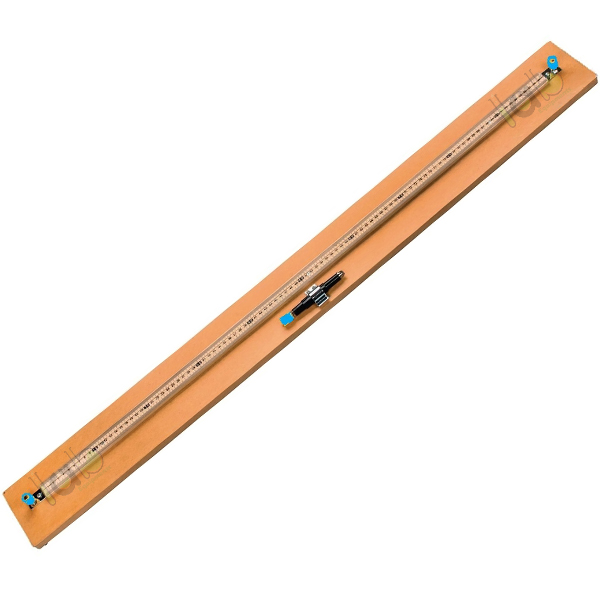
Potentiometer with Jockey Pencil
Product Code : EL-EAE-10290
Quick answer: The potentiometer with jockey is a slide-wire instrument used in physics practicals to compare the EMFs of two cells, find the internal resistance of a cell and measure small potential differences without drawing current. It has a wooden base with brass blocks, a 100 cm wooden scale and 4 mm socket terminals, and a jockey is supplied. Lab Exports manufactures it in Delhi for schools, colleges and universities.
Specifications
| Component | Specification |
|---|---|
| Base | Wooden, with brass blocks |
| Scale | 100 cm wooden scale |
| Terminals | 4 mm socket terminals |
| Jockey | Supplied with the potentiometer |
How the potentiometer experiment is done
A potentiometer measures EMF by balancing rather than by drawing current. A steady driver cell and a rheostat send a constant current along the uniform wire, so the potential drop per centimetre is the same all along it. When a cell is connected against this drop through a galvanometer and the jockey finds the null point, no current flows from that cell, and its EMF is proportional to the balancing length.
- Set up the primary circuit: driver battery, plug key and rheostat in series with the potentiometer wire.
- Connect the cell under test, positive terminal to the same end as the driver positive, through a galvanometer to the jockey.
- Press the jockey at points along the wire, without sliding it, until the galvanometer reads zero; note the balancing length.
- To compare two cells, repeat with the second cell: E1/E2 = l1/l2.
- For internal resistance, find l1 with the cell on open circuit and l2 with a resistance R across it: r = R(l1 - l2)/l2.
The driver current must stay constant through a set of readings, so re-check the balance for the first cell at the end of the experiment before working out the result.
Key features
- Wooden base carrying brass blocks for the wire and connections.
- 100 cm wooden scale for reading balancing lengths directly.
- 4 mm socket terminals that accept standard laboratory leads.
- Jockey supplied for making point contact with the wire.
- Null-method measurement: EMF is found with no current drawn from the cell under test.
Documentation and supply
Installation instructions and a manual are supplied with the apparatus. Most Lab Exports products carry a one-year manufacturer warranty.
Lab Exports manufactures the potentiometer at its works in Laxmi Nagar, Delhi, and supplies it to schools, colleges and universities in India and 60+ countries, handling the export documents for each shipment. More about the company is on the About Lab Exports page.
Related Electrical and Electronics products
- Meter Bridge or Wheatstone Bridge with Pencil Jockey (EL-EAE-10289)
- Pencil Jockey (EL-EAE-10291)
- Rheostat Nichrome Wire Groove Type (EL-EAE-10288)
- Circuit Board Junior (EL-EAE-10292)
- Rheostat Constantine (Eureka) Wire (EL-EAE-10287)
- Circuit Board Senior (EL-EAE-10293)
The full range is in the Electrical and Electronics section of the Physics Lab range.
Frequently asked questions
What experiments can be done with this potentiometer?
Comparison of the EMFs of two cells, determination of the internal resistance of a cell, and measurement of small potential differences, all by the null method.
What is the scale length of the potentiometer?
It has a 100 cm wooden scale for reading the balancing length.
What is the price of the potentiometer?
Prices are not published on the website. Add the potentiometer to the Enquiry Cart with the Add To Cart button on this page, or email [email protected] with the house code EL-EAE-10290 and the quantity, to receive a quotation.
Does Lab Exports manufacture the potentiometer?
Yes. Lab Exports manufactures the potentiometer at its works at 11/315, Lalita Park, Laxmi Nagar, Delhi 110092, under house code EL-EAE-10290.
Request a quote
Email [email protected] with the house code EL-EAE-10290 and the quantity, or add the potentiometer to the Enquiry Cart with the Add To Cart button on this page. Tender buyers can also see the Tenders and OEM page.