Tapping Key
Product Code : SCL-EAE-11283
Quick answer: The Tapping Key is a normally open, momentary-contact key: the circuit is completed only while the key is pressed and breaks as soon as it is released. It is used for brief galvanometer readings in Wheatstone bridge and resistance-comparison experiments, so that current passes only for the moment of observation. Lab Exports manufactures it in Delhi for schools, colleges and universities.
Specifications
| Parameter | Detail |
|---|---|
| Device type | Momentary electrical contact key |
| Normal contact state | Open when not pressed |
| Operating action | Manual press or tap |
| Primary function | Briefly making and breaking an electrical circuit |
| Supplied parts | Integrated momentary-contact mechanism with electrical connection terminals |
How the tapping key is used
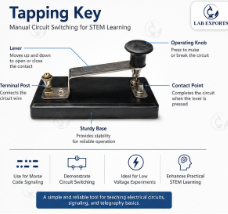
A tapping key is a normally open switch. Pressing it brings the contacts together and completes the circuit; releasing it separates them again. Because current flows only while the key is held down, it is the usual way to take a quick look at a galvanometer or detector without leaving current flowing through it.
In a Wheatstone bridge the key is placed in the galvanometer arm or the cell arm. A light tap shows the direction of deflection, the known resistance is adjusted, and the tap is repeated until the galvanometer shows no deflection. That null point marks balance, where P/Q = R/S.
- Place the key on a dry, stable, non-conductive bench and keep the supply off while wiring.
- Connect the key in series at the required point in the circuit.
- Check that the contacts are open with the key released, then switch on the low-voltage supply.
- Press the key briefly, note the galvanometer deflection, and release it at once.
Key features
- Normally open: the circuit stays broken until the key is pressed
- Momentary make-and-break action for short observations
- Limits current through galvanometers and other sensitive detectors
- Electrical connection terminals for standard laboratory leads
- Compact format for Wheatstone bridge and resistance-comparison set-ups
- Shows students the principle of a normally open switch
Documentation and supply
Most Lab Exports products carry a one-year manufacturer warranty.
Lab Exports manufactures the Tapping Key at its works in Laxmi Nagar, Delhi, and supplies it to schools, colleges and universities in India and 60+ countries, handling the export documents for each shipment. More about the company is on the About Lab Exports page.
Related Electrical and Electronics products
- Rheostat 8 Inches (SCL-EAE-11282)
- Rheostat 6 Inches (SCL-EAE-11284)
- Rheostat 10 Inches (SCL-EAE-11281)
- Four Way Plug Key (SCL-EAE-11285)
- Rheostat 12 Inches (SCL-EAE-11280)
- Reversing Key / Commutator (SCL-EAE-11286)
The full range is in the Electrical and Electronics section of the Physics Lab range.
Frequently asked questions
Why is a tapping key used instead of a plug key with a galvanometer?
A plug key stays closed until the plug is removed, while a tapping key conducts only while it is pressed. Brief contact avoids steady current through the sensitive galvanometer and limits heating of the resistances during bridge measurements.
Is the tapping key normally open or normally closed?
Normally open. The contacts close only while the key is pressed or tapped.
What is the price of the Tapping Key?
Prices are not published on the website. Add the Tapping Key to the Enquiry Cart with the Add To Cart button on this page, or email [email protected] with the house code SCL-EAE-11283 and the quantity, to receive a quotation.
Does Lab Exports manufacture the Tapping Key?
Yes. Lab Exports manufactures the Tapping Key at its works at 11/315, Lalita Park, Laxmi Nagar, Delhi 110092, under house code SCL-EAE-11283.
Request a quote
Email [email protected] with the house code SCL-EAE-11283 and the quantity, or add the Tapping Key to the Enquiry Cart with the Add To Cart button on this page. Tender buyers can also see the Tenders and OEM page.