Solar Toy Car Model
Product Code : SCL-EAE-11344
Quick answer: The Solar Toy Car Model is a renewable-energy teaching aid in which light falling on a photovoltaic element produces electrical power that drives the car's motor and wheels. It shows the chain from light energy to electrical energy to motion, and how light intensity and panel angle affect speed. Lab Exports manufactures it in Delhi for schools, STEM clubs and educational distributors.
Specifications
| Parameter | Detail |
|---|---|
| Product category | Solar energy educational model / STEM renewable-energy teaching aid |
| Model capacity | One-car demonstration model |
| Energy principle | Photovoltaic conversion of light energy for mechanical motion |
| Intended users | Students, teachers, school science laboratories and STEM clubs |
| Brand | Lab Exports |
How the model is used in teaching
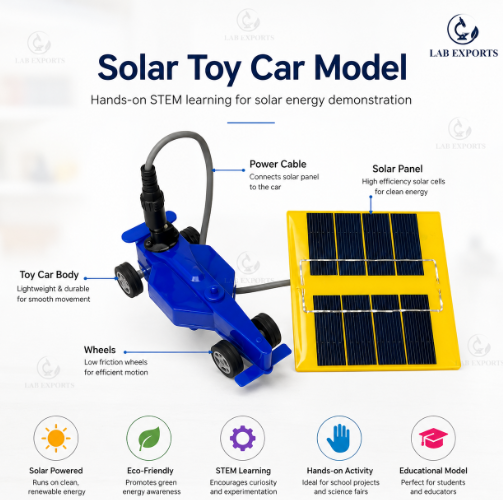
The car carries its own small photovoltaic element. Light striking it is converted into electrical energy, which runs the motor that turns the wheels, so a single glance shows the complete energy chain: light energy to electrical energy to kinetic energy. No fuel is burned, which makes the model a natural starting point for lessons on clean transport and renewable power.
Because the speed depends on how much light the panel receives, the model also invites simple investigations. Students can compare direct sunlight with shade or a lamp, tilt the car so the panel faces the light at different angles, and discuss the effect of friction and surface on motion.
- Place the car on a dry, smooth and level surface with open space ahead.
- Check that the wheels rotate freely and the parts are correctly fitted.
- Turn the photovoltaic surface toward direct sunlight or a suitable light source.
- Watch the motor start and the car move forward.
- Change the light level or angle and compare how the car responds.
Key features
- Direct demonstration of light, electrical generation and mechanical movement
- Links renewable-energy theory to a visible moving model
- Shows vehicle motion without any combustion-based power source
- Light intensity and panel position visibly affect operation
- Supports lessons on energy, electricity, motion, sustainability and engineering design
Documentation and supply
Most Lab Exports products carry a one-year manufacturer warranty.
Lab Exports manufactures the Solar Toy Car Model at its works in Laxmi Nagar, Delhi, and supplies it to schools, STEM clubs and educational distributors in India and 60+ countries, handling the export documents for each shipment. More about the company is on the About Lab Exports page.
Related Electrical and Electronics products
- Solar Educational Kit (SCL-EAE-11343)
- Faraday's Law Apparatus (SCL-EAE-11345)
- Solar LED Model (SCL-EAE-11346)
- Leclanche Cell Substitute (SCL-EAE-11341)
- Solar Fan Model (SCL-EAE-11347)
- Daniel Cell Substitute 1.08V (SCL-EAE-11340)
The full range is in the Electrical and Electronics section of the Physics Lab range.
Frequently asked questions
What does the solar toy car model demonstrate?
It demonstrates photovoltaic conversion of light into electrical energy and then into motion, and how light intensity and panel angle affect the car's performance.
Where is the solar car model used?
In school science lessons, supervised STEM club and project activities, and as a working exhibit at science fairs.
What is the price of the Solar Toy Car Model?
Prices are not published on the website. Add the Solar Toy Car Model to the Enquiry Cart with the Add To Cart button on this page, or email [email protected] with the house code SCL-EAE-11344 and the quantity, to receive a quotation.
Does Lab Exports manufacture the Solar Toy Car Model?
Yes. Lab Exports manufactures the Solar Toy Car Model at its works at 11/315, Lalita Park, Laxmi Nagar, Delhi 110092, under house code SCL-EAE-11344.
Request a quote
Email [email protected] with the house code SCL-EAE-11344 and the quantity, or add the Solar Toy Car Model to the Enquiry Cart with the Add To Cart button on this page. Tender buyers can also see the Tenders and OEM page.