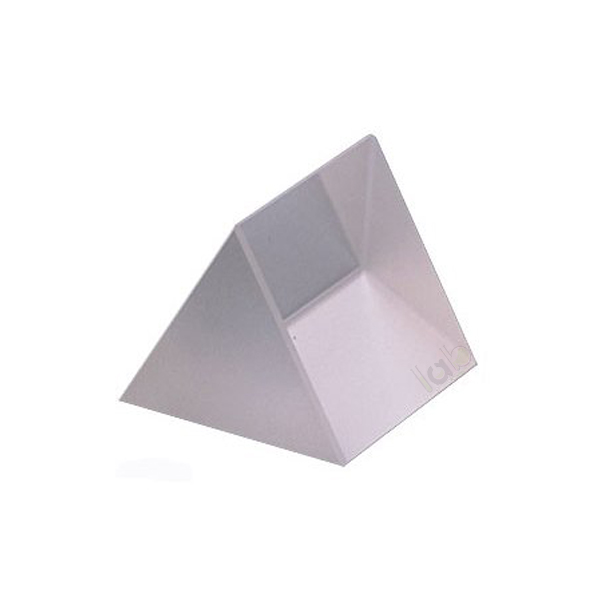
Prism Calcite/Quartz
Product Code : EL-LAO-10339
Quick answer: The Prism Calcite/Quartz is a polished crystal prism, made of calcite or quartz, with its optic axis parallel to the refracting edge. On a spectrometer it shows double refraction and is used to measure the refractive indices of the ordinary and extraordinary rays from their minimum deviations. Lab Exports manufactures it in Delhi for colleges and universities.
Specifications
| Component | Specification |
|---|---|
| Material | Calcite or quartz |
| Surfaces | Polished |
| Optic axis | Parallel to the refracting edge |
| Use | Crystal optics, double refraction and minimum deviation studies |
How the calcite or quartz prism experiment is done
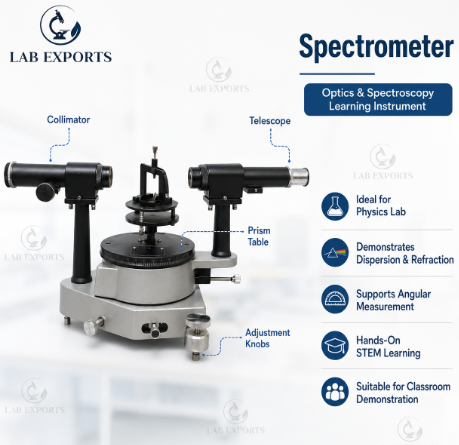
Calcite and quartz are birefringent: light entering the crystal splits into an ordinary ray, which obeys Snell's law with a single refractive index mu_o, and an extraordinary ray, whose index mu_e depends on direction. With the optic axis parallel to the refracting edge and the light travelling in a plane at right angles to it, both rays follow Snell's law, so each gives its own minimum deviation and its own refractive index from mu = sin((A + Dm)/2) / sin(A/2).
- Adjust the spectrometer for parallel light and level the prism table.
- Place the prism on the table and measure its refracting angle A.
- Illuminate the slit with a sodium lamp; two refracted images appear, one for each ray.
- Find the minimum deviation position for each image in turn and record Dm for both.
- Calculate mu_o and mu_e, and use a polaroid to show that the two images are polarised at right angles.
For calcite the ordinary index is greater than the extraordinary index, while quartz shows the opposite with a much smaller difference, a comparison that illustrates negative and positive crystals.
Key features
- Crystal prism in calcite or quartz for double refraction work.
- Polished faces for sharp spectrometer images.
- Optic axis parallel to the refracting edge, so both rays obey Snell's law at minimum deviation.
- Gives the ordinary and extraordinary refractive indices in one set-up.
- Suited to advanced optics practicals at college and university level.
Documentation and supply
Most Lab Exports products carry a one-year manufacturer warranty.
Lab Exports manufactures the calcite or quartz prism at its works in Laxmi Nagar, Delhi, and supplies it to colleges and universities in India and 60+ countries, handling the export documents for each shipment. More about the company is on the About Lab Exports page.
Related Light and Optics products
- Prism Different Angle (EL-LAO-10338)
- Acrylic Prism (EL-LAO-10340)
- Hollow Glass Prism (EL-LAO-10337)
- Prism Glass (EL-LAO-10341)
- Hand Lens with White Plastic Handle (EL-LAO-10342)
- Hand Lens with Black Plastic Case (EL-LAO-10343)
The full range is in the Light and Optics section of the Physics Lab range.
Frequently asked questions
Why are two images seen through a calcite or quartz prism?
The crystal is birefringent, so light splits into ordinary and extraordinary rays with different refractive indices, and each is deviated by a different amount.
What is the optic axis orientation of this prism?
The optic axis is parallel to the refracting edge of the prism.
What is the price of the calcite or quartz prism?
Prices are not published on the website. Add the calcite or quartz prism to the Enquiry Cart with the Add To Cart button on this page, or email [email protected] with the house code EL-LAO-10339 and the quantity, to receive a quotation.
Does Lab Exports manufacture the calcite or quartz prism?
Yes. Lab Exports manufactures the calcite or quartz prism at its works at 11/315, Lalita Park, Laxmi Nagar, Delhi 110092, under house code EL-LAO-10339.
Request a quote
Email [email protected] with the house code EL-LAO-10339 and the quantity, or add the calcite or quartz prism to the Enquiry Cart with the Add To Cart button on this page. Tender buyers can also see the Tenders and OEM page.