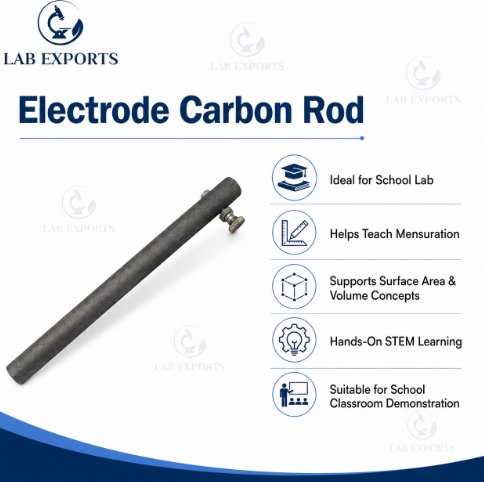
Electrode Carbon Rod
Product Code : SCL-EAE-11177
Quick answer: The electrode carbon rod is a graphite electrode used as an inert anode or cathode in school and college electrochemistry. It conducts well yet resists common classroom electrolytes, so it is used for the electrolysis of water, copper sulphate electrolysis and simple voltaic cell work, in voltameters and in beaker set-ups. Lab Exports manufactures it in Delhi for schools, colleges and universities.
Specifications
| Parameter | Specification |
|---|---|
| Material | High-purity graphite carbon |
| Electrical resistance | Low and uniform along the rod |
| Function | Inert anode or cathode conductor |
For rod diameter and length, and for bulk pack quantities, email [email protected] with the house code SCL-EAE-11177.
How it is used
In electrolysis, an inert electrode carries current into or out of the electrolyte without taking part in the reaction itself. Graphite is the usual choice for school work: it conducts electricity, is inexpensive, and does not dissolve or add unwanted metal ions to the solution as many metal electrodes would. The products formed at the electrode therefore come from the electrolyte alone, which keeps the chemistry clear for students.
Typical uses include the electrolysis of water, where hydrogen and oxygen are collected over the electrodes; the electrolysis of copper sulphate solution, where copper coats a carbon cathode; and simple cells in which carbon acts as the positive electrode, as in the Leclanche cell.
- Fit the rod through a rubber stopper of suitable size or into the electrode holder of the cell.
- Attach an insulated crocodile-clip lead from the low-voltage DC supply to the exposed end.
- Lower the rod into the electrolyte, keeping the clip clear of the liquid.
- After use, rinse the rod in water and dry it before storing.
Key features
- High-purity graphite carbon for good conductivity.
- Low, uniform electrical resistance along the rod.
- Resists corrosion in common classroom acids, bases and salt solutions.
- Fits rubber stoppers, electrode holders and voltameter set-ups.
- Suits both anode and cathode duty in low-voltage DC experiments.
Documentation and supply
A handling and safety instruction sheet is supplied with the rod. Most Lab Exports products carry a one-year manufacturer warranty.
Lab Exports manufactures the electrode carbon rod at its works in Laxmi Nagar, Delhi, and supplies it to schools, colleges and universities in India and 60+ countries, handling the export documents for each shipment. More about the company is on the About Lab Exports page.
Related Electrical and Electronics products
- Operational Amplifier Trainer (SCL-EAE-11176)
- Resistance Box 500 Ohms (SCL-EAE-11175)
- Resistance Box 50 Ohms (SCL-EAE-11174)
- Energy Band Gap Apparatus (SCL-EAE-11181)
- LED Characteristics Apparatus (SCL-EAE-11171)
- Resistance in Series and Parallel Apparatus (SCL-EAE-11187)
The full range is in the Electrical and Electronics section of the Physics Lab range.
Frequently asked questions
Why is carbon used as an electrode in electrolysis?
Graphite conducts electricity but resists attack by most classroom electrolytes, so it does not dissolve or interfere with the products of electrolysis.
Can the carbon rod be ordered in bulk?
Yes. Bulk pack quantities are available on request for institutions; state the quantity needed in the enquiry.
What is the price of the electrode carbon rod?
Prices are not published on the website. Add the electrode carbon rod to the Enquiry Cart with the Add To Cart button on this page, or email [email protected] with the house code SCL-EAE-11177 and the quantity, to receive a quotation.
Does Lab Exports manufacture the electrode carbon rod?
Yes. Lab Exports manufactures the electrode carbon rod at its works at 11/315, Lalita Park, Laxmi Nagar, Delhi 110092, under house code SCL-EAE-11177.
Request a quote
Email [email protected] with the house code SCL-EAE-11177 and the quantity, or add the electrode carbon rod to the Enquiry Cart with the Add To Cart button on this page. Tender buyers can also see the Tenders and OEM page.