Digital Transistor Characteristics Apparatus
Product Code : SCL-EAE-11331
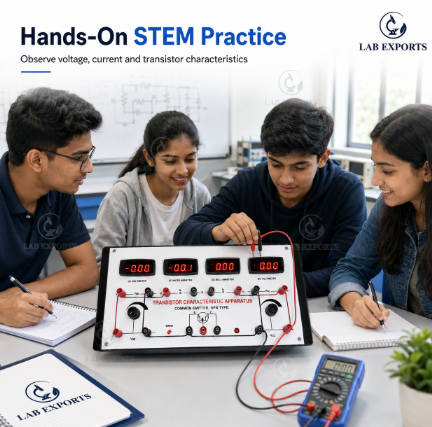
Quick answer: The Digital Transistor Characteristics Apparatus is used in electronics practicals to study how a transistor responds to changes in its input and output conditions, and to plot its input and output characteristic curves from recorded readings. Lab Exports manufactures it in Delhi for schools, colleges and universities.
Specifications
For the full specification of the Digital Transistor Characteristics Apparatus, email [email protected] with the house code SCL-EAE-11331.
How it is used in teaching
Transistor characteristics are a core practical in physics and electronics courses. The input characteristic shows how the input current changes with input voltage, while the output characteristics show how the output current depends on output voltage for several fixed input currents. Together the curves explain how a transistor can act both as an amplifier and as a switch.
As the name indicates, this is the digital version of the apparatus, intended to give numerical readings so that students can record closely spaced values without scale-reading errors and draw smoother curves. The configuration, transistor type and display ranges of this model are stated in the quotation.
- Identify the transistor terminals and set the supplies to minimum before switching on.
- Record input current for a series of input voltages with the output voltage held constant.
- Fix an input current and record output current as the output voltage is varied; repeat for other input currents.
- Plot the characteristic curves and use the readings to estimate current gain.
Key features
- Intended for transistor input and output characteristic practicals
- Digital format for direct numerical readings
- Supports plotting of characteristic curves from tabulated readings
- Links transistor theory with measured results in the laboratory
- Suitable for supervised electronics and semiconductor-device practicals
Documentation and supply
Most Lab Exports products carry a one-year manufacturer warranty.
Lab Exports manufactures the Digital Transistor Characteristics Apparatus at its works in Laxmi Nagar, Delhi, and supplies it to schools, colleges and universities in India and 60+ countries, handling the export documents for each shipment. More about the company is on the About Lab Exports page.
Related Electrical and Electronics products
- Transistor Characteristics Apparatus (Socket Type) (SCL-EAE-11330)
- Battery Eliminator (Socket) (SCL-EAE-11332)
- Transistor Characteristics Apparatus (SCL-EAE-11329)
- Battery Eliminator 2-12V 2A (SCL-EAE-11333)
- Digital Zener Diode Apparatus (SCL-EAE-11328)
- Battery Eliminator AC/DC (SCL-EAE-11334)
The full range is in the Electrical and Electronics section of the Physics Lab range.
Frequently asked questions
What is the digital transistor characteristics apparatus used for?
It is used to record transistor readings and plot input and output characteristic curves in electronics and physics practicals.
What do transistor characteristic curves show?
They show the cutoff, active and saturation regions of the transistor and allow its current gain to be estimated, explaining its use as an amplifier and a switch.
What is the price of the Digital Transistor Characteristics Apparatus?
Prices are not published on the website. Add the Digital Transistor Characteristics Apparatus to the Enquiry Cart with the Add To Cart button on this page, or email [email protected] with the house code SCL-EAE-11331 and the quantity, to receive a quotation.
Does Lab Exports manufacture the Digital Transistor Characteristics Apparatus?
Yes. Lab Exports manufactures the Digital Transistor Characteristics Apparatus at its works at 11/315, Lalita Park, Laxmi Nagar, Delhi 110092, under house code SCL-EAE-11331.
Request a quote
Email [email protected] with the house code SCL-EAE-11331 and the quantity, or add the Digital Transistor Characteristics Apparatus to the Enquiry Cart with the Add To Cart button on this page. Tender buyers can also see the Tenders and OEM page.