Ohm Meter Shunt Type

Product Code : SCL-LM-11339
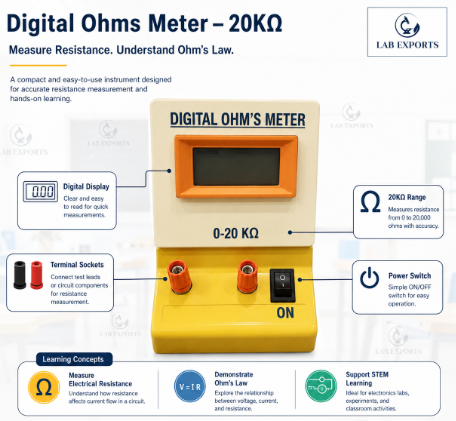
Quick answer: The Ohm Meter Shunt Type is an educational resistance meter in which the unknown resistor is connected in parallel with the meter movement. It is used to measure low resistances and to demonstrate how a shunt-type ohmmeter works and how current divides in a parallel branch. Lab Exports manufactures it in Delhi for schools, colleges and universities.
Specifications
| Parameter | Value |
|---|---|
| Instrument type | Educational shunt-type resistance meter |
| Function | Resistance measurement and shunt-ohmmeter demonstration |
| Scale | Resistance-calibrated meter scale |
Resistance range, battery and terminal details are not stated on this page; give the range needed when requesting a quote.
How it is used
In a series-type ohmmeter the unknown resistance is placed in series with the meter, and the scale reads zero ohms at full deflection. A shunt-type ohmmeter works the other way round: a battery drives current through a limiting resistor and the meter, and the unknown resistance Rx is connected across the meter as a shunt. When Rx is zero the meter is short-circuited and reads zero; as Rx increases, more current passes through the meter, until with the terminals open it reaches full-scale deflection. The scale therefore increases from left to right and is most open at low values, which is why this type is used for low resistances.
- Make sure the resistor under test is disconnected from any supply.
- Connect the unknown resistor across the test terminals.
- Read the resistance from the resistance-calibrated scale.
- Compare the reading with the value from the resistor's colour code.
- Repeat with resistors of different values and note how the deflection changes with Rx.
Key features
- Demonstrates the shunt-type principle, with the test resistance in parallel with the meter.
- Resistance-calibrated scale for direct readings.
- Suited to measuring low resistance values.
- Shows current division in a parallel branch as Rx changes.
- Saves building the complete ohmmeter circuit for each practical.
Documentation and supply
Most Lab Exports products carry a one-year manufacturer warranty.
Lab Exports manufactures the shunt-type ohm meter at its works in Laxmi Nagar, Delhi, and supplies it to schools, colleges and universities in India and 60+ countries, handling the export documents for each shipment. More about the company is on the About Lab Exports page.
Related Lab Meters products
- Multi Range Digital Desk Stand Meter (SCL-LM-11301)
- MR66 Moving Coil Meter (SCL-LM-11291)
- MR66 Analog Panel Meter (SCL-LM-11290)
- MO65 Analog Panel Meter (SCL-LM-11289)
- Travelling Microscope (SCL-LM-11256)
- Screw Gauge / Micrometer (SCL-LM-11255)
The full range is in the Lab Meters section of the Physics Lab range.
Frequently asked questions
What is the difference between a shunt-type and a series-type ohmmeter?
In a shunt-type ohmmeter the unknown resistance is connected in parallel with the meter, so zero resistance gives zero deflection; in a series-type ohmmeter it is in series, and zero resistance gives full deflection.
Why is a shunt-type ohmmeter used for low resistances?
Its scale is most spread out at the low-resistance end, so small resistances can be read more easily than on a series-type meter.
What is the price of the shunt-type ohm meter?
Prices are not published on the website. Add the shunt-type ohm meter to the Enquiry Cart with the Add To Cart button on this page, or email [email protected] with the house code SCL-LM-11339 and the quantity, to receive a quotation.
Does Lab Exports manufacture the shunt-type ohm meter?
Yes. Lab Exports manufactures the shunt-type ohm meter at its works at 11/315, Lalita Park, Laxmi Nagar, Delhi 110092, under house code SCL-LM-11339.
Request a quote
Email [email protected] with the house code SCL-LM-11339 and the quantity, or add the shunt-type ohm meter to the Enquiry Cart with the Add To Cart button on this page. Tender buyers can also see the Tenders and OEM page.