Human Circulatory System
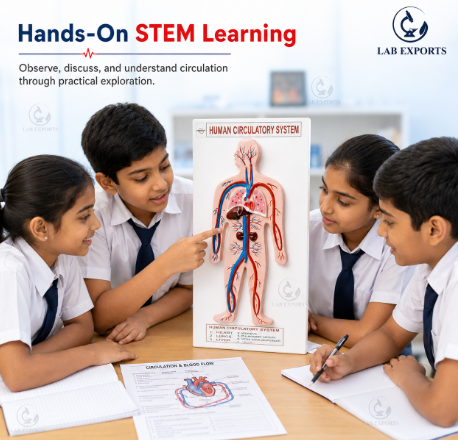
Product Code : SCL-HSM-11377
Quick answer: The Human Circulatory System model shows the arterial and venous systems together with the heart, lungs, liver, spleen and kidneys, set against a partial skeleton for reference. It is used to teach where the major blood vessels run in relation to the organs and skeletal landmarks. It is coloured, numbered and mounted on a base, with a key card. Lab Exports manufactures it in Delhi for schools, colleges and universities.
Specifications
| Feature | Detail |
|---|---|
| Vascular display | Arterial and venous systems shown together |
| Organs included | Heart, lungs, liver, spleen and kidneys |
| Skeletal reference | Partial skeleton for locating vessels and organs |
| Finish | Coloured and numbered |
| Mounting | On a base |
| Key card | Supplied |
How the model is used in teaching
Blood leaves the heart in arteries and returns in veins. In the systemic circuit, the aorta and its branches supply the organs and the veins bring blood back to the right side of the heart; in the pulmonary circuit, blood passes through the lungs to take up oxygen before returning to the left side. Showing arteries and veins on one model lets students follow both circuits.
The partial skeleton gives fixed landmarks, so students can relate a vessel to the bone it runs beside, and the included organs show how the vessels connect with the heart, lungs, liver, spleen and kidneys. Teachers use the numbered structures with the key card for identification tests and revision before practical examinations.
Key features
- Arterial and venous systems displayed together
- Heart, lungs, liver, spleen and kidneys integrated with the vessels
- Partial skeleton provides reference points
- Coloured and numbered for structured identification
- Mounted on a base and supplied with a key card
Documentation and supply
A numbered key card is supplied with the model. Most Lab Exports products carry a one-year manufacturer warranty.
Lab Exports manufactures the Human Circulatory System model at its works in Laxmi Nagar, Delhi, and supplies it to schools, colleges and universities in India and 60+ countries, handling the export documents for each shipment. More about the company is on the About Lab Exports page.
Related Human System Model products
- Jumbo Human Stomach (SCL-HSM-11378)
- Jumbo Human Heart Model (SCL-HSM-11374)
- Human Nervous System (SCL-HSM-11380)
- Human Torso Model (SCL-HSM-11366)
- Human Lung Model in Bell Jar (EL-HSM-10492)
- Protein Structure Model (EL-HSM-10491)
The full range is in the Human System Model section of the Biology Lab range.
Frequently asked questions
What does the human circulatory system model show?
The arterial and venous systems together with the heart, lungs, liver, spleen, kidneys and a partial skeleton.
Why does the model include a partial skeleton?
The skeleton provides reference points for locating vessels and organs, so students can relate each vessel to nearby bony landmarks.
What is the price of the Human Circulatory System model?
Prices are not published on the website. Add the Human Circulatory System model to the Enquiry Cart with the Add To Cart button on this page, or email [email protected] with the house code SCL-HSM-11377 and the quantity, to receive a quotation.
Does Lab Exports manufacture the Human Circulatory System model?
Yes. Lab Exports manufactures the Human Circulatory System model at its works at 11/315, Lalita Park, Laxmi Nagar, Delhi 110092, under house code SCL-HSM-11377.
Request a quote
Email [email protected] with the house code SCL-HSM-11377 and the quantity, or add the Human Circulatory System model to the Enquiry Cart with the Add To Cart button on this page. Tender buyers can also see the Tenders and OEM page.