Electric Bell Demonstration
Product Code : SCL-EAE-11257
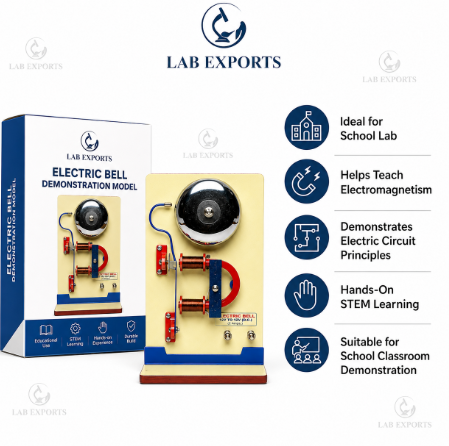
Quick answer: The Electric Bell Demonstration is an open-board model that shows every working part of an electric bell: electromagnet coils, armature, striker, contact mechanism and gong. Connected to a low-voltage DC supply, it rings by repeated make-and-break action, teaching the magnetic effect of current and self-interrupting circuits. Lab Exports manufactures it in Delhi for schools and colleges.
Specifications
| Component | Specification |
|---|---|
| Type | Electric bell demonstration apparatus |
| Main parts | Bell gong, electromagnet coils, armature, striker, contact mechanism and terminals |
| Mounting | Parts arranged on a demonstration board with supporting base |
| Supply | Low-voltage DC |
How the electric bell works
When the circuit is closed, current flows through the electromagnet coils and magnetises the core. The electromagnet pulls the soft-iron armature towards it, so the striker hits the gong. The same movement opens the contact, the current stops, the electromagnet loses its magnetism and a spring returns the armature, closing the contact again. This make-and-break cycle repeats many times a second and the bell rings continuously.
- Place the board on a dry bench and check that the armature moves freely.
- Connect the terminals to a low-voltage DC supply through a switch or push button.
- Close the switch and watch the armature, striker and contact as the bell rings.
- Open the circuit and discuss what each part did during one cycle.
Because every part is exposed, students can follow the conversion of electrical energy into magnetic, mechanical and finally sound energy, and see a practical use of an electromagnet that switches itself on and off.
Key features
- All working parts open to view: coils, armature, striker, contact and gong
- Exposed electromagnet coils for explaining the magnetic effect of current
- Demonstration-size gong heard clearly by a whole class
- Accessible terminals for connection to a laboratory DC supply
- Parts mounted on one board and base for tidy classroom presentation
- Shows a self-interrupting (make-and-break) circuit in action
Documentation and supply
Most Lab Exports products carry a one-year manufacturer warranty.
Lab Exports manufactures the electric bell demonstration model at its works in Laxmi Nagar, Delhi, and supplies it to schools and colleges in India and 60+ countries, handling the export documents for each shipment. More about the company is on the About Lab Exports page.
Related Electrical and Electronics products
- Potentiometer Apparatus (SCL-EAE-11258)
- Step Down Transformer (SCL-EAE-11259)
- Resistance Coil (SCL-EAE-11260)
- Leclanche Cell 1.5V (SCL-EAE-11261)
- Nichrome Wire (100gm) (SCL-EAE-11252)
- Resistance Coil Unit (SCL-EAE-11262)
The full range is in the Electrical and Electronics section of the Physics Lab range.
Frequently asked questions
How does an electric bell work?
Current magnetises an electromagnet, which pulls the armature so the striker hits the gong. That movement breaks the circuit, the armature springs back, the circuit closes again and the cycle repeats.
What supply does the electric bell demonstration need?
It runs from a suitable low-voltage DC supply, such as a battery eliminator or cells, connected to its terminals.
What is the price of the electric bell demonstration model?
Prices are not published on the website. Add the electric bell demonstration model to the Enquiry Cart with the Add To Cart button on this page, or email [email protected] with the house code SCL-EAE-11257 and the quantity, to receive a quotation.
Does Lab Exports manufacture the electric bell demonstration model?
Yes. Lab Exports manufactures the electric bell demonstration model at its works at 11/315, Lalita Park, Laxmi Nagar, Delhi 110092, under house code SCL-EAE-11257.
Request a quote
Email [email protected] with the house code SCL-EAE-11257 and the quantity, or add the electric bell demonstration model to the Enquiry Cart with the Add To Cart button on this page. Tender buyers can also see the Tenders and OEM page.